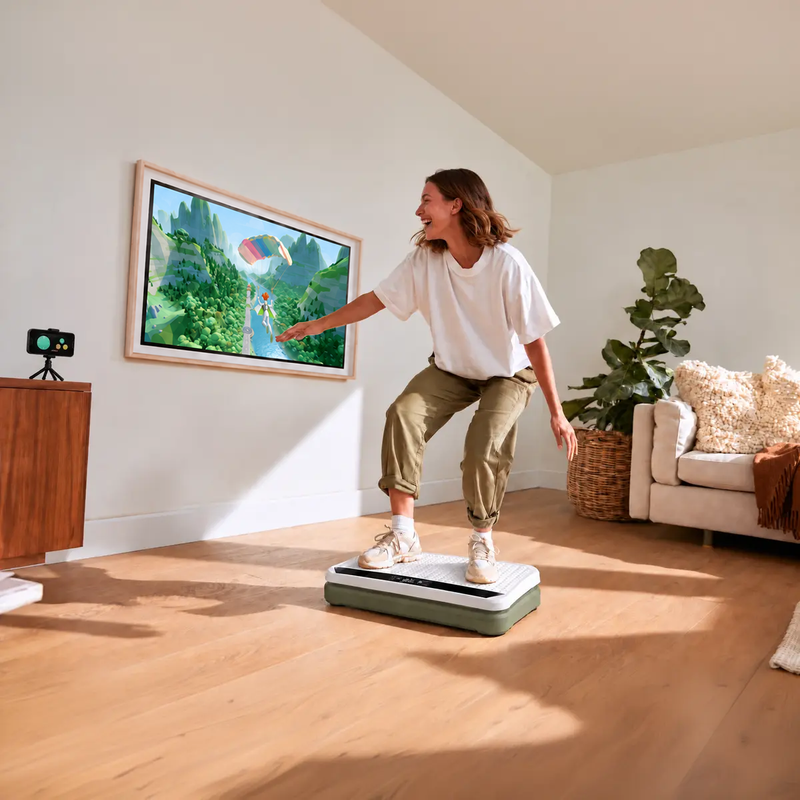
Their immediate purpose is to get you moving through comfortable positions after a long stretch in your chair.
There is evidence that vibration adds muscle activity during exercise. A trial involving 15 healthy middle-aged and older women, mean age 60.8, measured leg muscle activity during squats on a vibrating platform (Dose-Response, 2022). That finding helps explain the interest in these machines, though its relevance to desk stiffness remains untested.
What the research means for your stiff hips
The trial measured immediate electrical activity during one session. Moving squats produced more activity than holding the squat still, but the researchers followed nobody over time. We therefore have no answer from this trial about lasting benefits or relief from a ten-minute desk break.
The distinction matters when you picture using a plate between meetings. Higher electrical activity tells researchers that muscles responded during the exercise. It leaves open whether your hips will feel easier afterward, how long any change might last, and whether vibration adds anything useful for that purpose.
Shallow squats take your hips through bending and straightening; weight shifts let you practice moving your body over your feet. Those are practical reasons to try them, with any change in stiffness something to observe for yourself.
If you already own a plate, vibration adds a moving surface beneath those familiar movements. Your thighs may feel busier during a shallow squat, although personal sensation varies. A stronger sensation alone tells you little about what repeated sessions will accomplish.
A ten-minute routine you can follow at a glance
Each two-minute block contains two rounds of 30 seconds of movement and 30 seconds paused. Across the sequence, that gives you five minutes of movement within ten elapsed minutes. Treat the timing as a convenient way to organize a break; researchers have not tested this particular routine.
All the movements work as instructions for the floor, too. Keep fixed support within reach, and take time during the pauses to settle into the next position.
Minutes 0 to 2
Stand with your feet comfortably apart and your knees slightly bent, letting your arms rest naturally. This gives you time to settle into standing after sitting; if you keep bracing hard or straightening your knees, lower the setting or practice on the floor.
Minutes 2 to 4
With both feet planted, slowly move a little weight toward either foot, returning through the middle each time. Let your torso travel over your hips, and shorten the shift if your shoulders start swinging or the outside edge of a foot lifts.
Minutes 4 to 6
Bend your hips and knees into a shallow squat, then rise smoothly with a slight bend left in your knees. This brings some movement into the hips after holding them in a seated position; make the squat shallower if your heels lift or your torso folds forward.
Minutes 6 to 8
Place one foot slightly ahead and gently shift forward and back, changing the leading foot for the second movement interval. Keep your pelvis facing ahead and the movement small; use the floor if the platform leaves your feet cramped.
Minutes 8 to 10
Rest a hand on fixed support and bring most of your weight over one leg, leaving the other toes down as a kickstand. Use one side for each movement interval, returning to the earlier two-foot shifts if you begin gripping the support or repeatedly wobbling.
Choose a setting you can move with comfortably
Begin with the operating instructions and the device’s beginner setting. Learn how to stop the vibration before starting the clock, and stop it during each pause as the instructions direct. Let the timer wait while you get organized.
Your movement gives you useful feedback about the demand. Repeatedly locking your knees, rolling toward a foot’s outside edge, or gripping the support are reasons to lower the setting and make the movement smaller. Aim for a position you can hold while breathing easily.
Research offers limited help with choosing a universal setting. A scoping review covered adults aged 50 and over, including healthy people and people with sarcopenia, osteoarthritis, stroke or Parkinson's disease (Cureus, 2025). It found the most consistent improvements in muscle strength and function, with mixed results for balance.
That review mapped existing studies without calculating a combined effect size. The optimal frequency, dose and amplitude remain unknown. Borrowing a display setting from someone else’s machine therefore gives you little confidence that you are reproducing a studied program.
On the floor, adjust the effort by changing movement size and how much support you use. Once the sequence feels familiar, try changing a single detail, such as squat depth, while leaving the vibration setting unchanged.
Decide whether the break earns a place in your day
Try two convenient days during the first week as a scheduling experiment. After each break, notice whether standing and walking feel more comfortable, whether nothing much changed, or whether the routine felt like another chore. A brief note is enough to help you remember your experience.
On a low energy day, finish after the opening two blocks. Relaxed standing and small supported shifts give you a shorter option without making the whole sequence a requirement.
For a little variety, choose a slow song and let each weight shift settle smoothly with a musical phrase. Keep the movements small and leave the pauses in place. There is no need to keep up with a fast beat.
If you already own a plate, using it depends on whether you enjoy the added sensation and find yourself returning to it. Your experience may justify keeping it in the routine, while the evidence for desk-related stiffness remains unresolved.
Sources
Liu Y et al., Dose-Response. Effects of Whole-Body Vibration Training with Different Body Positions and Amplitudes on Lower Limb Muscle Activity in Middle-Aged and Older Women. 2022. pmc.ncbi.nlm.nih.gov
Alfieri GR et al., Cureus. Impact of Whole-Body Vibration Therapy in Elderly Populations: A Scoping Review. 2025. pmc.ncbi.nlm.nih.gov